
The current electricity market prices have arrived in HMKE.app
New chart, new decision-making opportunities – and one step closer to automatic, price-based energy management.
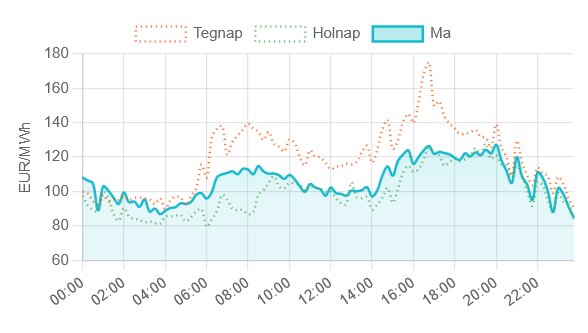
HMKE.app has been expanded with a new feature: it now displays the current European (HU) day-ahead electricity market price chart. This is not just an "interesting" or additional piece of information on the dashboard – but a fundamental data element on which smart automations can be built: when to consume more, when to cut back, when to charge, and when it is worth managing stored energy.
What is the day-ahead price and why does it matter?
The essence of the day-ahead market is that the prices for the next day's hourly (in many places quarter-hourly) periods are already established in advance, typically in the early afternoon (~12:30 PM onwards). This means the user does not have to guess afterwards but can plan ahead.
The HMKE.app chart helps you quickly see:
-
when cheap energy is expected,
-
when expensive energy is expected,
-
and how this changes throughout the day.
Why is this good for a household?
Most home consumption is not "carved in stone". There are many loads that can be scheduled or finely controlled:
Typical schedulable/reschedulable consumers:
-
water heater / DHW heating
-
washing machine, dryer, dishwasher
-
electric car charging
-
storage or auxiliary heating (if available)
-
air conditioning (pre-cooling / pre-heating)
-
battery charging (if storage is present)
If your system knows when electricity is cheap, it is worthwhile to shift these consumptions to cheaper time slots – thus reducing costs with minimal change in comfort.
The key extra: automation with the ADA P1 Meter rule system
The HMKE.app chart is useful on its own, but it truly becomes a "superpower" if you have the ADA P1 Metered device and use its rule system.
Here comes the idea: don't constantly monitor the prices yourself – let the system monitor them for you.
Simple example rule logics (in an understandable way)
-
Cheap period → charge / consume more
-
If the price is low, then:
-
the water heater can start,
-
larger consumers can be enabled,
-
EV charging can start,
-
or the battery can begin charging.
-
-
Expensive period → save / limit
-
If the price is high, then:
-
non-essential loads can be disabled or limited,
-
you can switch to “economical” mode (e.g., lower limit),
-
priority is given to locally produced energy (if solar panels exist).
-
-
Negative / extremely low price → strategic charging
-
On certain days, there may be very low (even extreme) prices. In such cases:
-
it might be worthwhile to charge the storage specifically,
-
or to "pre-perform" energy-intensive tasks.
-
Even more exciting with a battery: charge cheaply, use smartly later
If you have a battery system, then tracking market prices is especially valuable.
Logic:
-
In a low-price band you charge (from the grid or mixed).
-
In a high-price band the stored energy:
-
is either consumed locally (less expensive imports),
-
or in some collaborations can be better sold timing-wise.
-
Here an important sober remark: time-optimized sales typically work best if there is an aggregator / market partner who also monitors market prices and organizes sales accordingly. The HMKE.app chart forms a common basis in this: it is transparent and trackable when consumption/charging/discharging happens in what price environment.
Why did we add this to HMKE.app?
Because the future of energy use is not only about "how much is consumed" but also about when it happens.
The goal of HMKE.app is not only to monitor but also to enable decision-making – and if you want, let the system decide smartly for you.
Brief summary
-
The current electricity market price chart is already available in HMKE.app.
-
It helps to make better timing decisions (consumption/charging/limiting).
-
With the ADA P1 Meter rule system, this can be automated.
-
With a battery system, the gain is even greater: cheap charging → usage/optimization in more expensive bands.
-
With an aggregator partner, “market” optimization can also become a realistic direction.