
When the solar system no longer just produces but also thinks
The world of solar systems has changed a lot in recent years. It used to be simple: the solar panel produced electricity, which the house consumed, and the rest went back to the grid. Today, however, it matters when we produce, when we consume, when we charge the battery, and when we sell energy.
The new rule of 21st-century energy use is simple: Produce. Use. If there is surplus, sell it—but at the best price possible.
This is where the ADA P1 Meter and the associated HMKE.APP system help.
No longer just monitoring the electricity meter
The ADA P1 Meter was originally designed to read the most important data from the digital electricity meter: how much the home consumes, how much energy goes back to the grid, and what is currently happening at the connection point.
This alone is a huge step forward because one of the biggest drawbacks of most solar systems is that the owner cannot see precisely what is happening in real-time between the house and the grid. However, with new developments, the ADA P1 Meter can do much more than that.
The system can cooperate with several well-known inverter types, so it not only sees data from the meter but also the inverter’s production, the battery status, and can consider the system’s operation. This means the ADA P1 Meter is no longer just a data-collecting device but is increasingly becoming a smart energy control center.
Proven technology with real users
This is not just a future promise or a concept in a test phase. Currently, more than 1,400 ADA P1 meters are operating live in the country. Nothing better proves the system's stability and success than the fact that it saves and processes data daily from about 300 subscriber users on the HMKE.APP dashboard and the PWA application.
Energy use controlled based on stock market prices
For solar systems, a crucial question is increasingly when it is worth feeding back to the grid. There are periods when the stock market electricity price is low, even negative. In such cases, selling generated energy is particularly unwise, as feeding back is economically disadvantageous.
The essence of the ADA P1 Meter and HMKE.APP developments is that the system does not operate blindly but monitors the current market situation. While providers often work with 15-minute delays or averaging, the ADA P1 Meter continuously updates its data every 10 seconds.
This speed is highly significant in smart control. If the stock market price suddenly turns negative, the ADA can intervene immediately, for example by directly regulating a Fronius inverter via TCP, stopping or limiting unnecessary feed-in without delay. Instead, the energy can be stored in the battery or cover the house’s own consumption. Later, in the evening hours when the stock market price is higher, the system can use or sell the previously stored energy at a much more favorable time.
Simply put: Don't sell electricity when nobody needs it. Sell it when it has value.
Smarter with a battery
The real power of battery systems is not only that they store energy produced during the day. The true value appears when the system consciously manages the battery.
The ADA P1 Meter's smart control can support operation where the system does not recklessly drain the battery. The goal is not to feed back at all costs but to keep the home energy supply safe.
In other words, the logic is not “sell everything,” but rather: Sell when it pays off—but only as long as the home’s energy needs are safely met.
This is especially important for systems whose owners want not only to save but also actively participate in exploiting energy market opportunities.
Smart and AI-based automations in the background
Complex smart controls work in the background. The system takes into account electricity meter data, inverter status, current production, consumption, battery charge, and stock market prices. The goal is so the user doesn't have to manually switch, calculate, or constantly watch charts.
The task of smart automation is for the system to decide independently when it is worth producing, when to reduce the inverter, when it is advisable to charge the battery, and when it is a good decision to sell stored energy at a higher price.
This is no longer the old “produce or not produce” thinking. This is financial optimization.
HMKE.APP – when data finally becomes understandable
The ADA P1 Meter collects and transmits data to the operated server, but the real experience is provided by HMKE.APP and hmke.app.
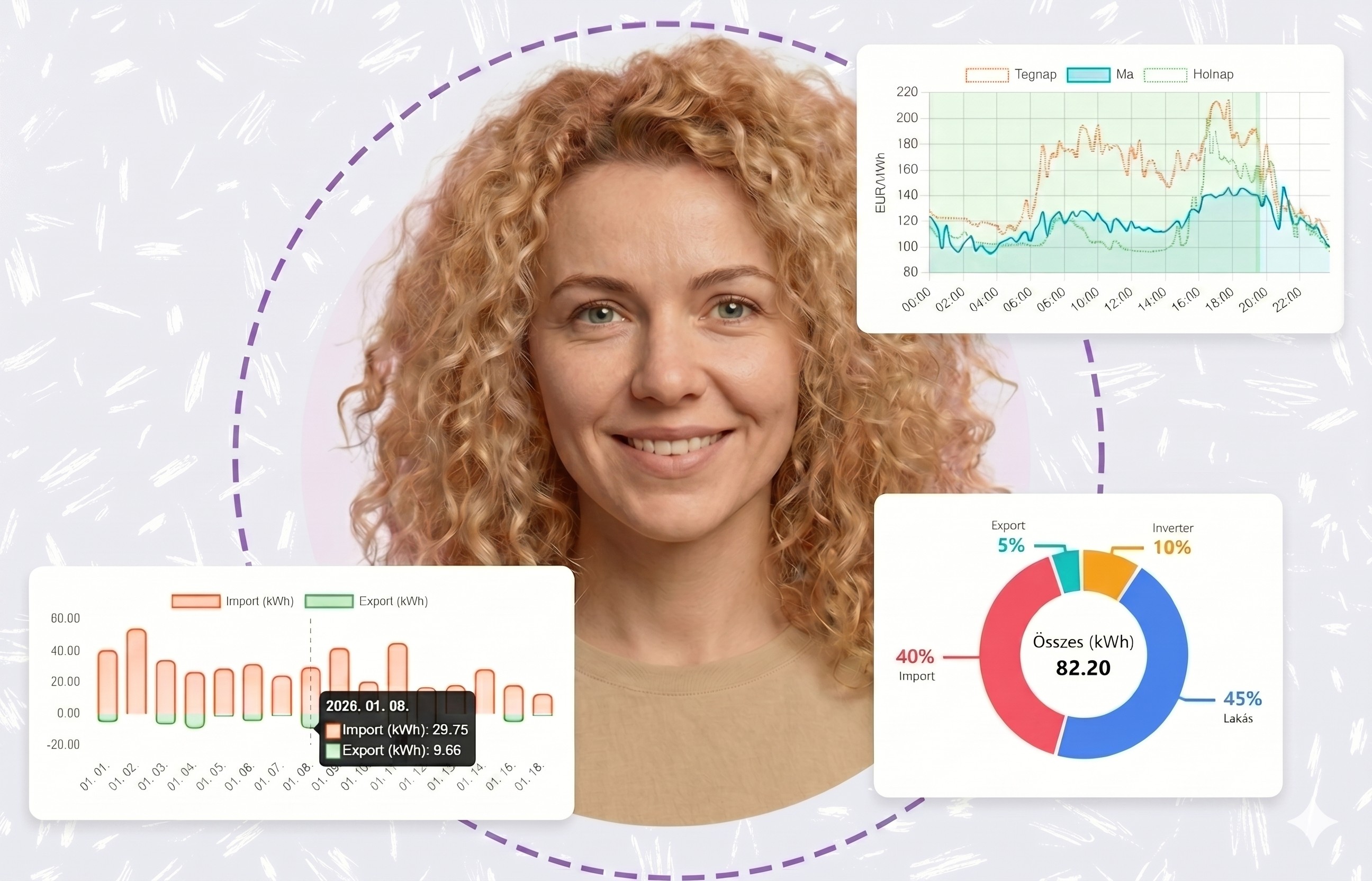
The interface no longer shows just dry numbers. The system creates online stock market charts, displays current prices, shows inverter production, and compares it to consumption or feed-in according to the meter. Thus the user finally sees the full picture in one place:
How much energy did the solar panel produce?
How much did the house consume?
How much was fed back to the grid?
When was the stock market price favorable or unfavorable?
How did the system perform financially?
The goal of HMKE.APP is exactly this: to make energy production an understandable, trackable, and financially interpretable system.
ADA485 – when the inverter also needs electricity meter data
Another important element of the development is ADA485. Many inverters work best when they continuously receive data from the electricity meter. This often requires a separate meter, distinct RS485 wiring, or new cable installation. This can be troublesome, expensive, or simply inconvenient in many places.
The ADA P1 Meter and ADA485 pair offer an elegant solution to this. The ADA P1 Meter reads data from the digital electricity meter, and ADA485 can forward this to the inverter using known, common meter protocols (e.g., CHINT or Eastron format).
In short: less wiring, less installation, less cost—yet more data and smarter operation.
Earning money with unused but generated energy
A solar system today is no longer just about lowering the electricity bill. With a well-built system, the generated but unused energy can become real value.
Three things are needed for this: production, measurement, and smart decision.
Production is provided by the solar panel.
Measurement is provided by the ADA P1 Meter.
The smart decision is made by HMKE.APP, smart control, and automation.
The user doesn't have to be an energy trader to enjoy the benefits. The logic is simple:
If the price is low or negative: It is not worth selling. Smart control steps in and focuses on internal consumption or storage.
If the price is high: Then it makes sense to feed into the grid to maximize profit.
If there is a battery: The system builds a bridge between the two states, storing cheap electricity to sell it later at a higher price.
This is the foundation of modern solar thinking. Not only producing. Producing smart. Storing smart. And selling smart.
This is just the beginning
The development of the ADA P1 Meter is continuously progressing. Inverter support, ADA485 integration, HMKE.APP stock market charts, and smart controls all point in the same direction: toward a system where household solar production is not an isolated technical device but part of an intelligent, financially optimized energy hub.
And the story doesn't stop here. New features, new automations, and further developments are coming. In fact, soon we will introduce a new, currently secret device with which we will take an even bigger step in the smart energy world.
The direction is clear: the future solar system not only produces. It watches, calculates, decides—and works best when it matters most.