
A new era begins in home energy use
In recent years, many households have expressed the need to see more precisely how much electricity they consume, when their solar panel systems produce power, and what is really happening behind the electricity meter. This was an important first step. But the next phase of energy use is no longer just about seeing the data.
It's about taking action based on that data.
The ADA P1 Meter was originally created to make the data readable from a digital electricity meter easily, understandably, and in real time. The device can collect nearly 40 measurement data points, including consumption, feed-in, phase, and grid data, then transmit these via MQTT, JSON API, Home Assistant integration, cloud or local network. It also has its own web interface and OTA firmware updates.
However, today this is just the foundation.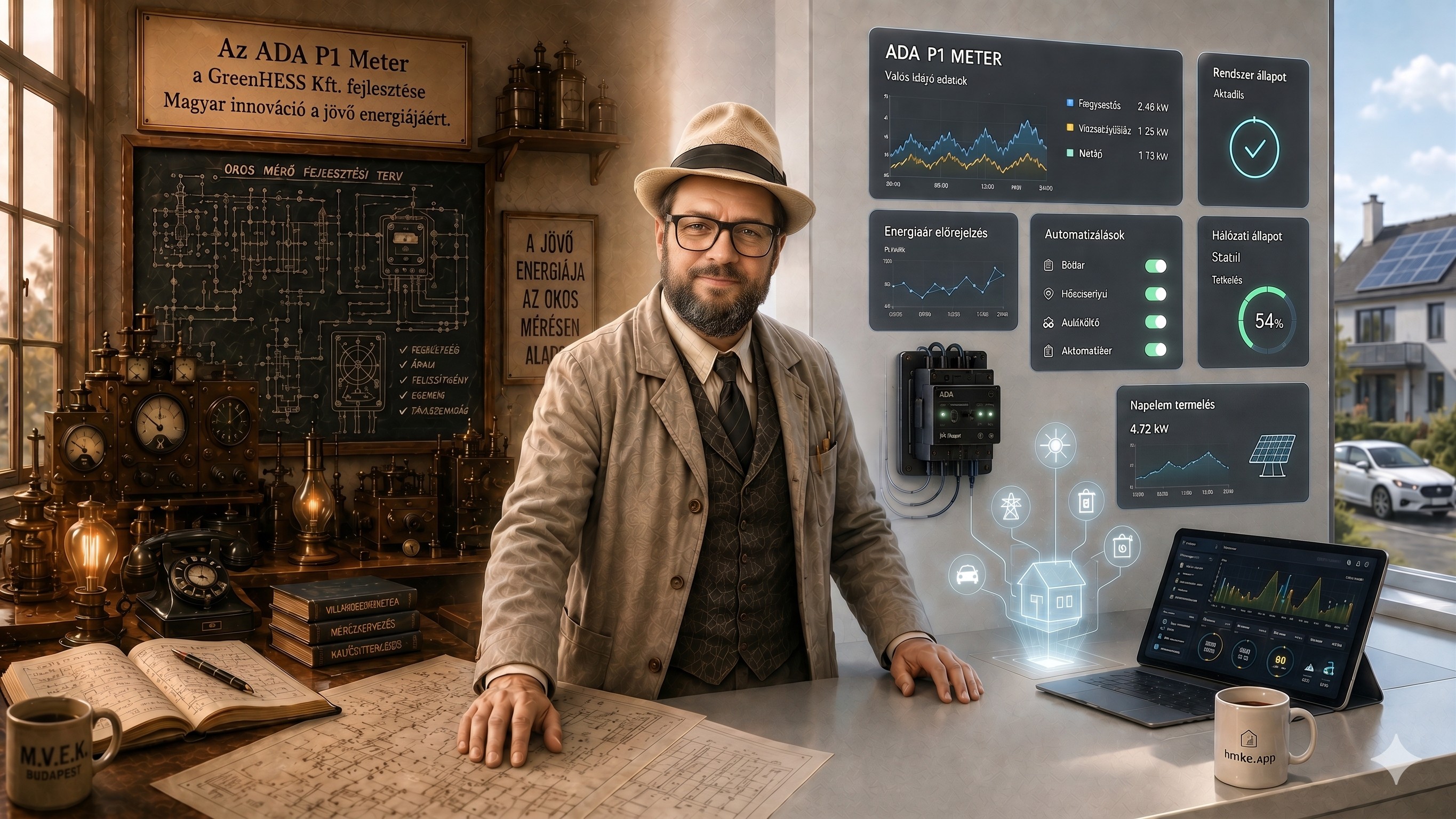
The electricity meter is more than just a measurement point
In modern home energy use, the electricity meter data is like a compass. It shows where energy flows, when there is surplus production, when consumption increases, when we burden the grid, and when it would be worthwhile to use electricity differently.
The essence of this shift in mindset is simple:
we don’t use energy when we’re used to, but when it’s smartest.
This is especially important for solar panel systems, but not only for them. Even households without solar panels can gain great value from timed, conscious consumption. The operation of a boiler, heat pump, electric car charger, air conditioner, or other large consumer can often be shifted to periods when energy use is more favorable, the grid is less loaded, or the own system works more efficiently.
When data turns into automation
The ADA P1 Meter's new role is exactly this: it not only collects data but can operate as a central element of a mini energy automation system.
Through the local network it can communicate with other devices, read data, and for certain systems perform control tasks. Examples include an inverter, a consumer, relay control, an energy storage environment, or other smart devices connected to the grid.
This is no longer simple monitoring.
This is local energy management.
The difference is huge. Monitoring shows that something is wrong. Automation can intervene before the situation becomes unfavorable.
A particularly big step for solar panel systems
Household solar systems previously worked on a fairly simple logic: when the sun shone, they produced; whatever the house did not consume was fed into the grid by the system.
However, this model is becoming less ideal. The grid cannot accept unlimited energy from many small producers at all times. In certain periods, overproduction can be problematic, and the electricity market environment is increasingly dynamic.
This is where the ADA P1 Meter's mindset shift comes in.
If the device sees the electricity meter data, senses feed-in, monitors consumption, and can communicate with other systems, then there is an opportunity for the household to become an active participant in the energy system instead of a passive one.
For example:
- consumers can be started in case of surplus production,
- in cases of excessive feed-in the inverter’s output can be reduced,
- charging and discharging can be optimized in battery systems,
- detrimental, even negative stock market price periods can be avoided in aggregator sales,
- unnecessary grid withdrawals or feed-ins can be reduced when network load is high.
The goal is not for the user to look at graphs all day. Rather, the system should help make better decisions in the background based on clear rules.
Useful even for those without solar panels
It is important that smart energy use is not only a privilege of solar households.
In a home without solar panels, consumption can also be optimized. If the user can see when and how energy is consumed, they can more easily rearrange the operation of large energy-consuming devices. If later the system connects to dynamic tariffs, timed controls, or external price signals, then the household may be able to draw power from the grid more smartly.
This does not necessarily mean a complicated system. Often it's a big step forward if not all devices operate simultaneously during peak times.
Energy efficiency is not just about using less. It is also about using it at better times.
Less burdened grid, more stable system
Many small household decisions add up.
If more and more homes manage their consumption and production intelligently, it benefits not only users but also the distribution network. Reducing peak loads, cutting unnecessary feed-ins, and increasing local energy use all contribute to a more stable, balanced energy system.
This is especially important at a time when more households have solar panels, batteries, electric cars, heat pumps, or other high-power consumers.
The future electricity system will not only consist of large power plants and central controls. Households, local decisions, and automated controls will play an increasingly important role.
Not instead of Home Assistant, but as a simpler entry point
The ADA P1 Meter does not want to compete with major home automation systems. For example, Home Assistant remains an excellent choice for those wanting a deeply customizable, complex smart home system.
But not everyone wants or is able to operate a separate server, install integrations, edit YAML files, or build a complete smart home infrastructure.
The advantage of ADA P1 Meter and hmke.app is precisely their simplicity.
The goal is an easily manageable energy automation layer that brings smart energy use closer to those who are not developers, not system administrators, and do not want to maintain a separate server.
You turn it on, set it up, see the data, and gradually start automating what you previously managed manually or not at all.
Control returns to the user
The price, availability, and grid management of energy will become increasingly important issues. The old approach saw the user only as a consumer: power came from the grid and a bill arrived at month’s end.
The new approach views the user as an active participant.
Measure, decide, automate, optimize.
The ADA P1 Meter can be a simple yet important tool in this change. A gateway between the electricity meter, inverters, consumers, cloud services, and local automation.
This new era is not about everyone becoming an energy expert.
It’s about our homes finally being able to handle energy more intelligently.
Step into the era of smart energy use!